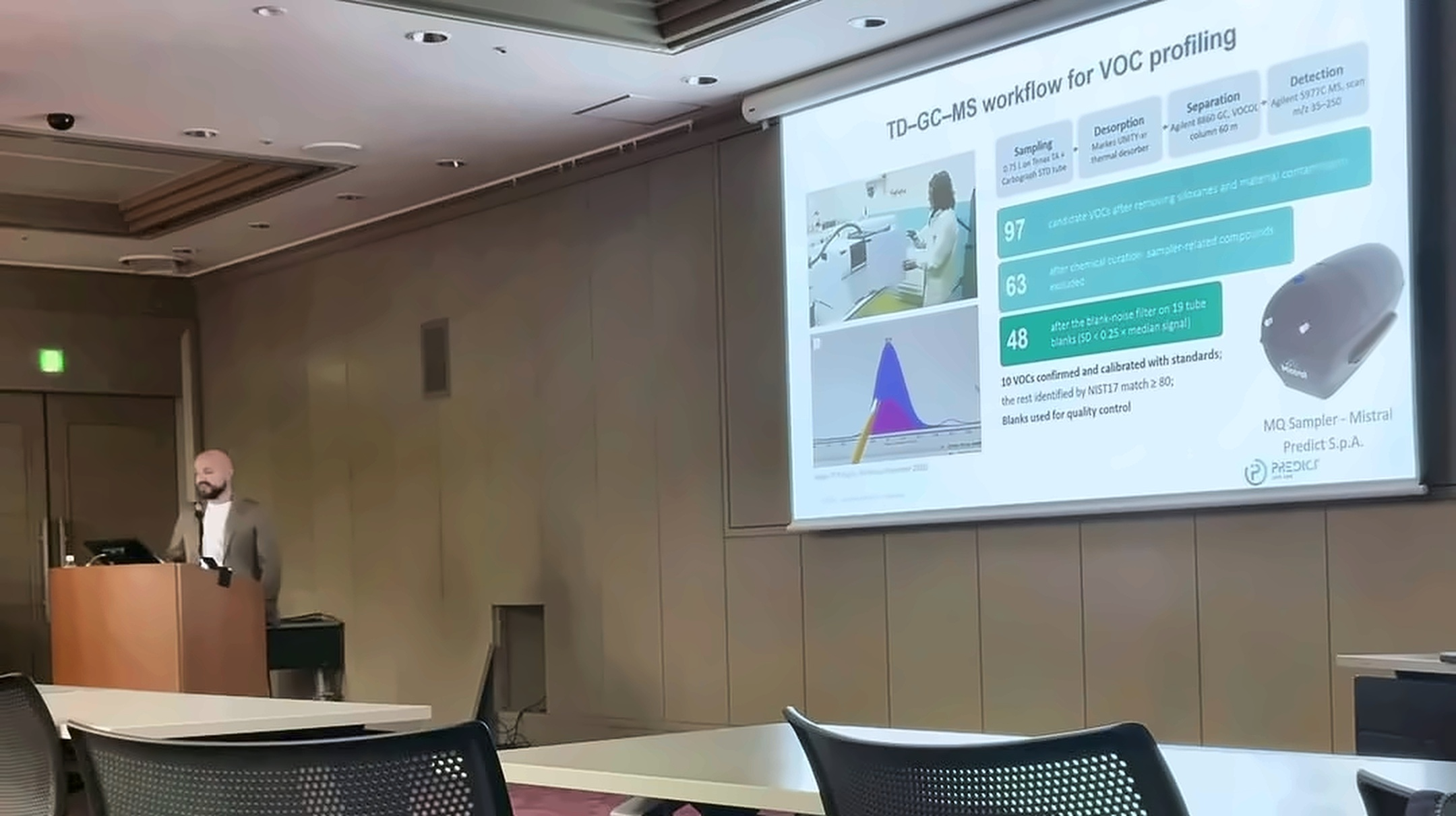
From 1 to 5 November, Tokyo hosted the IABR Breath Summit 2026, one of the world’s leading events dedicated to breath analysis research. During this time, the PolySenSe Lab presented its study on breathing and urban pollution. Among the presentations was ‘Development and validation of a breath-based tool for urban pollution exposure assessment’, a study conducted by the PolySenSe Lab of the Interdepartmental Department of Physics and presented by PhD candidate Silvano Spagnolo. This is significant recognition for Italian research, made possible in part by the use of two Mistral samplers.
The study begins with a simple question: E-bikes and e-scooters are becoming increasingly popular, but their users often travel in heavy traffic alongside cars. To what extent does urban pollution affect their breath composition?
To find out, volunteers travelled approximately 9 km through rush-hour traffic in Bari. Before and after the journey, the researchers used a Mistral sampler to collect breath and room air samples, which they then compared.
The most significant finding relates to benzene, a carcinogenic pollutant associated with traffic. Following the ride through the city, the level of benzene in the breath of the participants increased by approximately 60%, even though the substance was absent from the air in the room. This suggests that the body was expelling the benzene inhaled during the journey. Therefore, benzene emerges as the most promising candidate for measuring actual exposure to urban air pollution.
Although ARPA monitoring stations measure the city’s air quality, they cannot determine how much of that pollution is absorbed by people travelling through the streets. Breath analysis can help to fill this gap. Indeed, a simple breath sample can reveal which substances have entered the body during a journey. This enables us to shift our focus from measuring environmental conditions to assessing their actual impact on people.
We are proud of the recognition that this research has received in Tokyo, and we are delighted to be collaborating with the PolySenSe Lab. We will continue to follow the developments of this research closely, as it brings breath analysis ever closer to everyday life.
*Research funded by MOST – NextGenerationEU, under the Italian National Recovery and Resilience Plan (PNRR), and by the Italian Ministry of University and Research (MUR) through the Departments of Excellence 2023–2027 programme (QuaSiModO).