A. Picciariello, A. Dezi, C. Tanzi, G. Tomasicchio, G. De Gennaro, A. Digilio, J. Palmisani, S. Spagnolo, D.F Altomare, M. De Fazio, L. Vincenti
IRCCS “S. De Bellis”, Department of Surgery, Castellana Grotte, Italy
University of Salento, Department of Experimental Medicine, Lecce, Italy
University “Aldo Moro” of Bari, Department of Precision and Regenerative Medicine and Jonic Area (DiMePRe-J), Bari, Italy
Introduction: Colorectal cancer (CRC) remains a leading cause of cancer-related mortality worldwide, underscoring the need for accurate and patient-friendly screening tools. Breath analysis has emerged as a non-invasive approach for disease detection based on volatile organic compounds (VOCs) that reflect metabolic alterations.
Aims & Methods: This study aims to evaluate whether VOC patterns in exhaled breath can discriminate CRC patients from healthy controls and support early detection.
Breath samples were collected using a standardized device under controlled conditions to minimize environmental variability. VOCs were analysed by thermal desorption–gas chromatography–mass spectrometry (TD-GC-MS). Initial univariate analysis was performed, followed by multivariate feature selection to identify relevant compounds. Class imbalance was addressed using random undersampling. Machine learning models were developed using selected VOCs and evaluated by 5-fold cross-validation. Ambient air samples were analysed to assess environmental influence, and VOCs significantly affected by background air were excluded to focus on endogenous compounds.
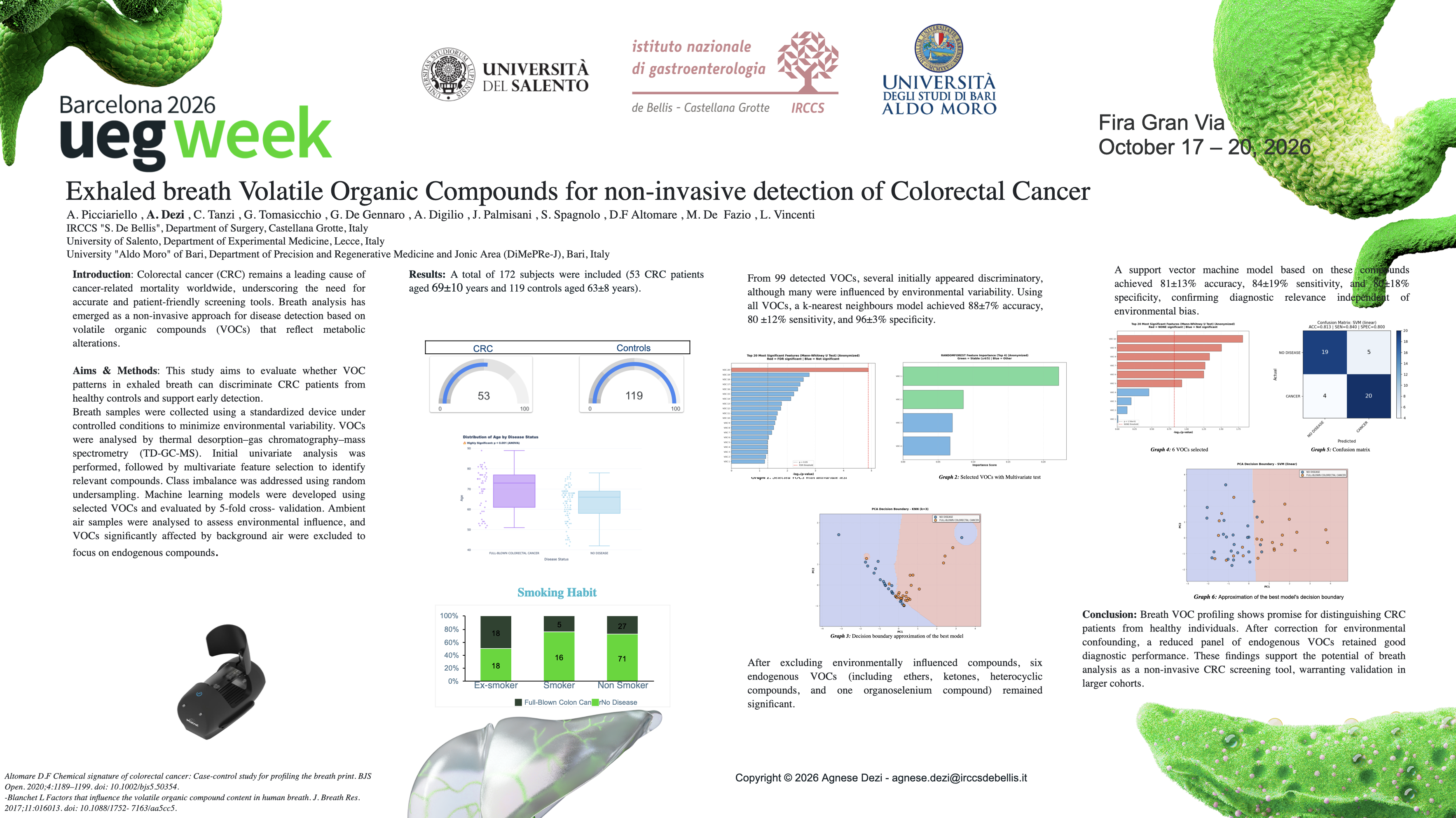
Results: A total of 172 subjects were included (53 CRC patients aged 69±10 years and 119 controls aged 63±8 years).
From 99 detected VOCs, several initially appeared discriminatory, although many were influenced by environmental variability. Using all VOCs, a k-nearest neighbours model achieved 88±7% accuracy, 80 ±12% sensitivity, and 96±3% specificity.
After excluding environmentally influenced compounds, six endogenous VOCs (including ethers, ketones, heterocyclic compounds, and one organoselenium compound) remained significant.
A support vector machine model based on these compounds achieved 81±13% accuracy, 84±19% sensitivity, and 80±18% specificity, confirming diagnostic relevance independent of environmental bias.
Conclusion: Breath VOC profiling shows promise for distinguishing CRC patients from healthy individuals. After correction for environmental confounding, a reduced panel of endogenous VOCs retained good diagnostic performance. These findings support the potential of breath analysis as a non-invasive CRC screening tool, warranting validation in larger cohorts.